How Reading’s work environment shapes aerial-access decisions
Projects across Reading often involve tall racking, mezzanines, and production lines where a lift must fit through standard doorways, ride unfinished floors, or sit directly under a task at height. In older industrial buildings under redevelopment, ceiling clearances and uneven slabs can vary bay by bay. Those conditions steer the comparison between slab electric scissor lifts, rough-terrain models, and articulated solutions.
Key factors to confirm before selecting a category: - Floor bearing capacity and slab condition in industrial sites and renovated spaces - Doorway widths, elevator limits, and aisle turning radii in local distribution buildings - Required platform height versus the ability to position the machine directly below the work - Indoor air-quality rules that may limit engine-powered options - Seasonal snow, ice, and freezing temperatures that affect traction outdoors
Electric scissor versus rough-terrain in Reading
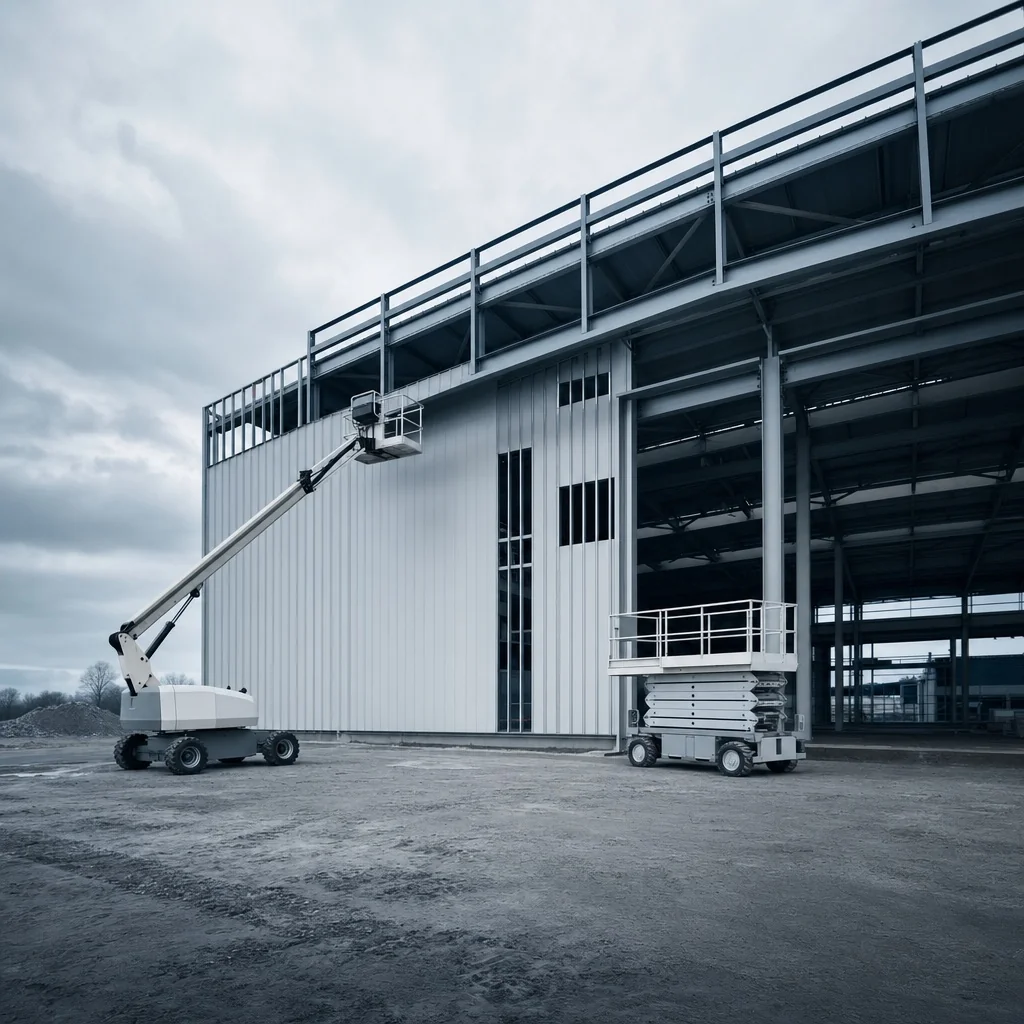
Electric scissor lifts match indoor maintenance and inventory work where smooth slabs and tight aisles are typical. They offer compact footprints for navigating storage areas and production corridors. Rough-terrain scissor lifts become relevant on construction lots, mill yards, and hilly approaches near residential slopes, where grade and ground conditions demand higher clearance and traction. When a task sits offset from the machine or obstacles interrupt a straight lift, consider a boom category highlighted on the aerial-lift-rental and articulating-boom-lift-rental pages.
Planning around winter and terrain
From late fall through early spring, outdoor work windows tighten. Many crews pivot to indoor repairs, lighting, and racking changes with electric-scissor-lift-rental. For exterior envelope work where snowbanks and frozen ground linger, rough-terrain-scissor-lift-rental or an all-terrain telehandler may better handle staging materials to safer, flatter areas. Actual site conditions, the selected unit’s instructions, and project procedures govern whether and when elevated work proceeds.
What this site covers
- Scissor lift categories for slabs and uneven ground
- Boom lifts for outreach around obstacles
- Vertical mast options for narrow-aisle indoor tasks
- Material handling for staging: forklifts and telehandlers
- Temporary site support such as power and lighting
Browse the full lineup at products, or read focused comparisons at boom-lift-rental, telescopic-boom-lift-rental, vertical-mast-lift-rental, and forklift-rental. For questions, head to contact.